



Author: Logan Hardy
Editor: Alex Papineau
When people start planning a golf simulator, the conversation usually begins with the launch monitor. That makes sense. It’s the piece that captures your ball flight and club data, and it’s the piece everyone has an opinion about.
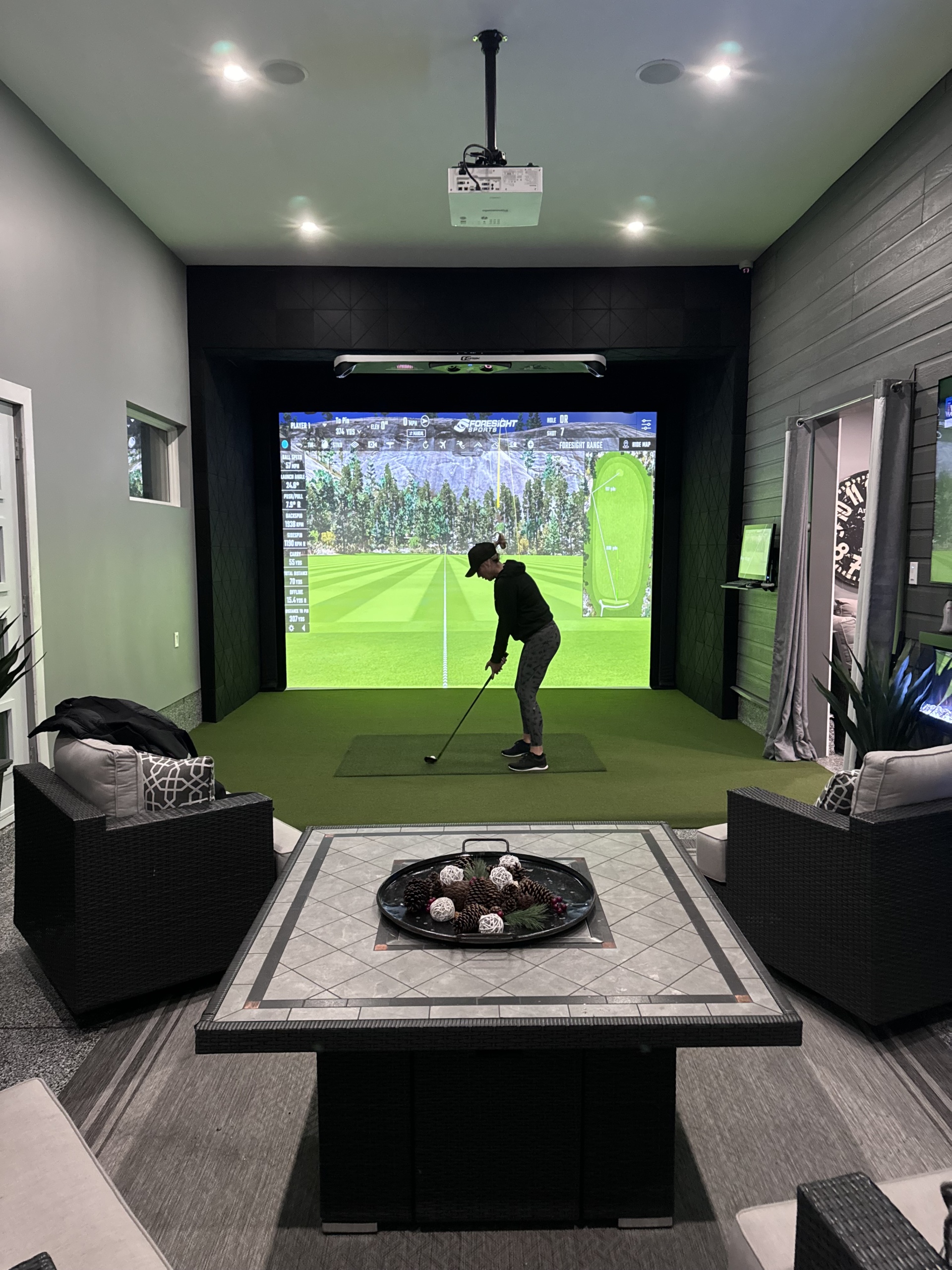
But walk into a truly great simulator room and the launch monitor is probably the last thing you notice. What you notice is the picture on the screen, the feel of the turf under your feet, the way the lighting makes the whole space feel intentional, and the fact that nothing looks like an afterthought. A premium room works because every component has been chosen to work with every other component.
Let’s take the room apart, piece by piece.
The Foundation: Room Dimensions and Planning
Everything starts with the space itself. Ceiling height, width, and depth determine what’s possible: whether a full driver swing is comfortable, how far the projector can sit from the screen, and where the player, the screen, and the seating should live relative to one another.
This is also where mistakes get expensive. A projector mounted a few inches off, a ceiling that’s slightly too low for your tallest golfer, or a room that’s just narrow enough to make left-handed play awkward are all things that are far easier to solve on paper than after the drywall is up.
The Screen and Enclosure
The impact screen is more than a white rectangle. It has to absorb repeated, high-speed ball strikes, display a crisp image, and do both without excessive bounce-back or noise. Material, tension, and mounting all affect image quality and durability.
The enclosure around it matters just as much. A well-built frame keeps the screen taut, protects the surrounding walls, and gives the room a finished, architectural look rather than a “net in the garage” feel. Side panels, headers, and masking all contribute to both safety and aesthetics.
The Projector
Projector choice is a balancing act between brightness, resolution, throw distance, and room conditions. A projector that looks fantastic in a showroom can disappoint in a room with the wrong ceiling height or too much ambient light.
Throw distance is the detail that catches people out. The projector’s lens has to fill the screen from where you can actually mount it, and it needs to sit where it won’t get hit by a stray shot or cast a shadow on the player. That’s an engineering question, not a catalogue question.
The Simulator PC
The computer is the quiet engine of the whole experience. It runs the software, renders the courses, and processes the data coming from the launch monitor. An underpowered machine means stuttering graphics and laggy shot feedback, which breaks the immersion instantly.
Just as important is how it’s installed: ventilation, cable routing, remote access, and placement so it’s accessible for servicing but out of sight and out of harm’s way.
The Hitting Surface and Turf
This is where your body meets the room. The hitting mat and surrounding turf affect how the club interacts with the ground, how your joints feel after a long session, and how realistic your practice is.
A good hitting surface is forgiving without being fake. It should let the club glide through the way it would on grass, hold up to heavy use, and sit flush with the surrounding flooring so you’re never fighting a lip or an uneven edge. The turf surrounding the hitting area also sets the visual tone of the room, so it’s worth getting the color and texture right.
Ceiling and Wall Protection
Golf balls are unforgiving, and so are drywall and light fixtures. Ceiling and wall protection is the unglamorous, essential layer that keeps errant shots from damaging your investment.
The goal is to protect the room without making it look like a padded cell. Done well, protection is integrated into the design with matching colors and clean lines, so it reads as part of the room rather than a bolt-on safety measure.
Lighting
Lighting is one of the most underrated parts of a simulator build, and one of the trickiest. The room has to be dark enough for the projected image to look vivid, yet bright enough for you to see your ball, your stance, and the people around you.
A premium room uses layered, controllable lighting: dimmable zones, light placed to avoid washing out the screen or casting shadows across the hitting area, and options for different moods, from focused practice to a relaxed evening with friends. It should also work with the launch monitor’s sensors, since poor lighting can interfere with some tracking technologies.
Furniture and Comfort
A simulator room is a place people want to spend time in, which means it needs to be comfortable. Seating for friends and family, a spot for drinks, storage for clubs and accessories, and a layout that lets the next player wait without being in the swing path all make the space more usable.
This is where the room stops being a piece of equipment and becomes part of the home. The best builds are rooms people use for entertaining, family time, and quiet solo practice, not just a place to hit balls.
Electrical Planning
It’s the least exciting item on the list and one of the most important. Projectors, computers, audio systems, lighting, and charging all need power in the right places, and ideally on circuits that can handle the load.
Planning outlets, data lines, HDMI runs, and control wiring before the walls are closed makes for a clean, reliable installation. Retrofitting after the fact usually means visible cables, awkward workarounds, and compromises you’ll notice every time you walk in. We can help you and your contractor understand where certain items might be placed to allow for the smoothest possible installation and any support or upgrades that may come in the future.
The Technology: More Than a Launch Monitor
Of course, the launch monitor is still the heart of the system, and it should be matched to how you plan to use the room. But a premium room goes beyond ball and club data.
PuttView adds a dedicated putting experience, projecting a precise green onto the floor so you can read breaks and practice the part of the game where most strokes are won or lost. For golfers serious about lowering their scores, it’s a natural complement to the full-swing setup.
Swing Catalyst brings professional-grade video and biomechanical analysis into the room. Paired with force plates and synchronized video, it helps you and your coach see what’s actually happening in your swing, not just where the ball ended up. For players who want to improve, not just play, it turns the simulator into a genuine training facility.
Other complementary technologies can round out the room too, depending on whether the focus is entertainment, serious practice, coaching, or all of the above.
How Foresight Sports Canada Brings It All Together
Here’s the thing about everything above: each piece is a decision, and every decision affects the others. The projector affects the screen. The screen affects the enclosure. The ceiling height affects the swing space, the lighting, and the projector mount. The electrical plan affects everything.
Sourcing these components from different places and hoping they fit together is how people end up with rooms that almost work. Foresight Sports Canada approaches the project differently. We’re not simply a launch-monitor retailer. We design and deliver the whole room as a single engineered solution.
That means:
- Consultation and design that starts with your space, your goals, and your budget
- Component selection where every element is chosen to work with the rest
- Planning for the details that are easy to miss: throw distances, sightlines, and protection
- Professional installation and calibration so the room performs the way it was designed to
- Ongoing support after the build is finished
One project, one partner, one room that works.
Start With the Room, Not the Gear
If you’re thinking about a simulator, we’d encourage you to start with the space and the experience you want, and let the equipment follow. Get in touch with Foresight Sports Canada to talk through your room, your goals, and what a complete, engineered solution could look like.
FAQ
Do I need a dedicated room, or can I build a simulator in a garage or basement?
Both work well. Basements, garages, bonus rooms, and purpose-built spaces can all become excellent simulator rooms. What matters is planning for the specifics of the space, such as ceiling height, lighting, width, depth, and temperature.
What’s included in a complete simulator room?
A complete room brings together the launch monitor, impact screen and enclosure, projector, simulator PC, hitting surface and turf, lighting, ceiling and wall protection. Furniture and finishing touches can be part of the design too.
Is a premium simulator only for serious golfers?
Not at all. A well-designed room is just as much about entertaining friends and family as it is about practice. The same build can serve a casual weekend round, a league night, and a focused practice session.
What is PuttView, and do I need it?
PuttView is a putting technology that projects a precise green onto the floor so you can read breaks and practice putting realistically. It’s optional, but it’s a great addition for anyone who wants to improve the part of the game where most strokes are saved.
What does Swing Catalyst add to a simulator?
Swing Catalyst adds professional-grade video and biomechanical analysis. It helps golfers and coaches see what’s happening in the swing, not just where the ball went, which makes it a strong fit for players focused on improvement.
Can you install and support the room after it’s built?
Yes. Foresight Sports Canada handles the project from consultation and design through installation and calibration, and we continue to support the room after it’s complete.


